
October 2023, study conducted by Famivita with 2,500 participants between September 11 and 25, 2023: Blue November, Yellow September, Lilac March... Each month symbolically receives a color that highlights how essential it is to take care of our health. In this sense, we can say that the whole year is imbued with the theme of prevention. In fact, this is usually emphasized by the WHO, which recommends that every health interaction should always include prevention.
Especially with the arrival of Pink October, we cannot forget breast cancer – the campaign has been conducted annually worldwide since 1990, with widespread dissemination through the media, social events, and educational programs. In this regard, data published by the National Cancer Institute (INCA) for the three-year period from 2023 to 2025 estimate 74,000 new cases per year of this disease in the country.
On another front, there is cervical cancer, with INCA estimating 17,000 new occurrences of it in Brazil just for this year.
It is worth remembering that the best outcomes, in terms of treatment and quality of life, are directly related to early diagnosis, in the initial stages, and to the quick start of treatment. For this, preventive actions are fundamental, aiming to identify tumors at early stages to improve the chances of cure. In relation to this, our latest study found that 43% of Brazilian women do not undergo exams to prevent breast and/or cervical cancer..
Do you get exams for the prevention of breast and/or cervical cancer?
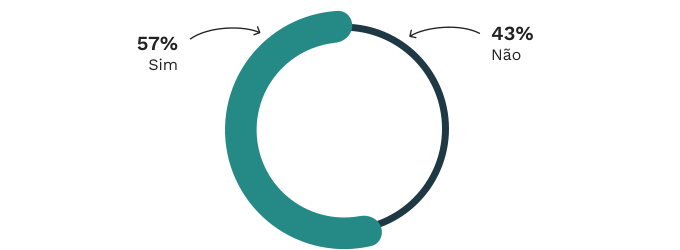
- Especially those in the age group 18 to 24 years old said they do not take these exams, with 61%.
- Of those 25 to 29 years old, 44% responded negatively.
- Of those 30 to 34 years old, this number was 30%.
- Over 35 years old, at least 79% underwent routine exams.
Prevention, shyness, and gynecological appointments
A survey carried out in 2019 by the Brazilian Federation of Gynecology and Obstetrics (Febrasgo) revealed that 4 million Brazilian women have never been to a gynecologist and another 5.6 million do not have the habit of visiting this professional, with 11% of the respondents citing embarrassment as the main reason.
Among the main exams relevant to the subject are the physical gynecological exam, which assesses a woman's whole body; the Pap smear, which prevents cervical cancer; the transvaginal ultrasound, which is able to detect lesions and other formations in the uterus; and the mammogram, which, although not a gynecological test, is always requested during a routine consultation with the gynecologist.
Regarding mammograms, it is also important to mention that performing self-exams every month does not replace it, although self-exams are very important. In addition, mammograms are offered to all women in Brazil through the Unified Health System (SUS), and health plans are even required to cover them.
Still related to the subject, 44% of respondents in our study said they found it difficult to schedule the routine annual gynecological exam.
Do you have trouble scheduling your routine annual gynecological exam?

- Mainly those between 18 and 24 years old stated that yes, they have difficulty scheduling their routine gynecological exam, with 53%.
- The age group between 30 and 34 years old finds it less difficult to schedule their routine gynecological exam, with 35%.
- Pregnant women also face less difficulties, with 37%.
- Women with children report more difficulties, with 47%, compared to women without children, with 39%.
HPV and the WHO Goal
Regarding cervical cancer, worldwide, the WHO estimates that 600,000 cases are diagnosed annually. Such figures have served as a significant warning for the organization. Therefore, in 2020, at the World Health Assembly, a goal was launched to reduce the incidence of this cancer to 4 cases, or even less, per 100,000 women by 2030.
Next year, by the way, will mark 10 years since the vaccine has been offered at SUS clinics for those aged 9 to 14. However, according to the Cancer Foundation, all capitals and regions of Brazil have vaccination rates against Human Papillomavirus below the target set by the National Immunization Program (PIN) and the WHO. And, related to this topic, 60% of the research participants said they had received the HPV vaccine.
- Especially in the 18 to 24 years old group, 78% reported having been immunized against the disease.
- Among those 25 to 29 years old, this number was 57%.
- Paraíba was the state where the most women said they had received the HPV vaccine.
- 1.Paraíba
- 2.Amapá
- 3.Piauí
- 4.Rondônia
- 5.Alagoas
- 6.Espírito Santo
- 7.Bahia
- 8.Sergipe
- 9.Pará
- 10.Amazonas
- 11.Ceará
- 12.Federal District
- 13.Acre
- 14.Goiás
- 15.Mato Grosso
- 16.Pernambuco
- 17.Maranhão
- 18.Tocantins
- 19.Minas Gerais
- 20.Santa Catarina
- 21.Paraná
- 22.Rio de Janeiro
- 23.São Paulo
- 24.Rio Grande do Sul
- 25.Mato Grosso do Sul
- 26.Rio Grande do Norte
- 27.Roraima


